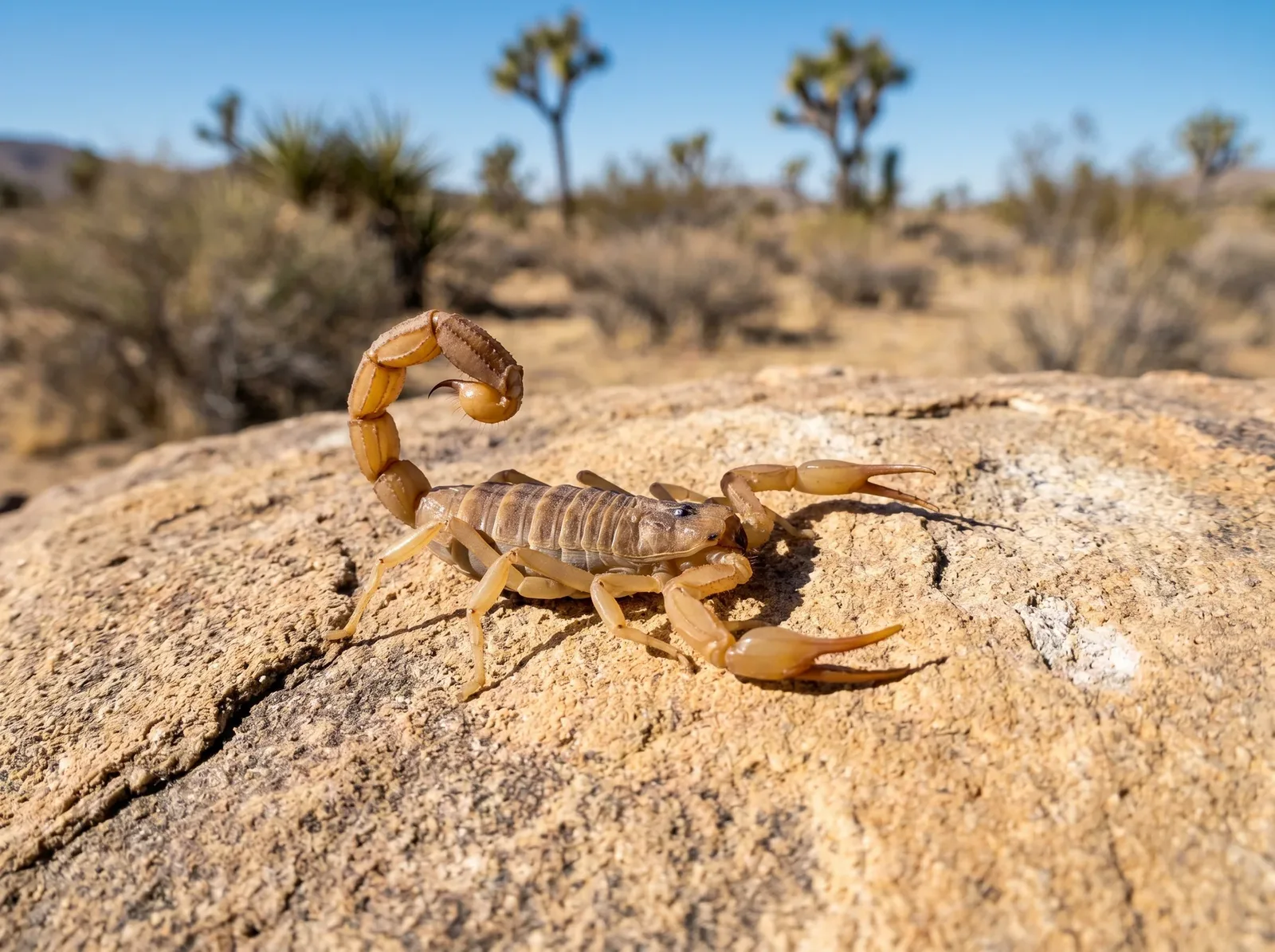
Every neighborhood in the Las Vegas valley has scorpions. Most of them never matter: they live in block walls and rock beds, they hunt at night, and they stay away from people. One species is different. The Arizona bark scorpion climbs walls and ceilings, slips through very small gaps, and is the scorpion that turns up in bathtubs, sinks and shoes. It is also the one with a sting worth taking seriously. This is what a valley homeowner should know about it: which one you are looking at, when they move, how to check your own yard in ten minutes, and what actually keeps them out of the house.
We run Vegas Scorpion Control, which handles scorpion inspection, home sealing and treatment for valley homes, and we are a guest here. Top of Las Vegas asked for the plain version, so this is it.
The three you are likely to see
Arizona bark scorpion. Two to three inches, slender, pale tan, with long thin pincers and a thin tail. This is the one that matters. The University of Arizona Cooperative Extension describes it as a climbing species that never burrows, which is exactly why it ends up indoors: it goes up stucco and block walls, along rooflines, and in through any opening it finds. Its sting causes immediate, intense pain, often with numbness and tingling. For most healthy adults that passes in one to three days. For small children, older adults and pets it can be serious.
Desert hairy scorpion. The largest scorpion in North America, up to about six inches, yellow with a darker back. It looks far worse than it is. It is a ground dweller and a burrower, it rarely comes inside, and its sting is usually compared to a bee sting, though anyone allergic should treat it like one.
Stripe-tailed scorpion. Small and stocky, with darker stripes along the tail. Common under rocks and in yards. A painful sting, but not a medically serious one for most people.
Where they live, and why some streets have more
Bark scorpions are not originally a Las Vegas animal. In 2006 the Nevada state entomologist told the Las Vegas Sun they first showed up in Southern Nevada around 1990 and have spread across the valley since. Today they are thickest where the desert meets new building. When a parcel is graded for a subdivision, the scorpions that lived there move into the nearest block walls, garages and rock landscaping. That is why the newer villages at the edge of the valley, in Summerlin, Henderson, Skye Canyon and the southwest, tend to see steady activity. Older neighborhoods have them too, especially yards with river rock, wood piles, palms or citrus.
Around a house, the usual hiding places are the hollow cells inside block walls, river rock and gravel beds, expansion joints and cracks in concrete, water meter boxes, pool equipment, and anything that sits undisturbed on the ground: planters, doormats, firewood, toys.
When they move
Activity runs from roughly April through October, heaviest in the hottest months, when scorpions follow crickets and other insects toward irrigated yards and cool houses. In winter they slow down and shelter. Bark scorpions sometimes gather in groups inside wall voids over the cold months, which is why one warm winter afternoon can suddenly produce several sightings in a single house.
Check your own yard in ten minutes
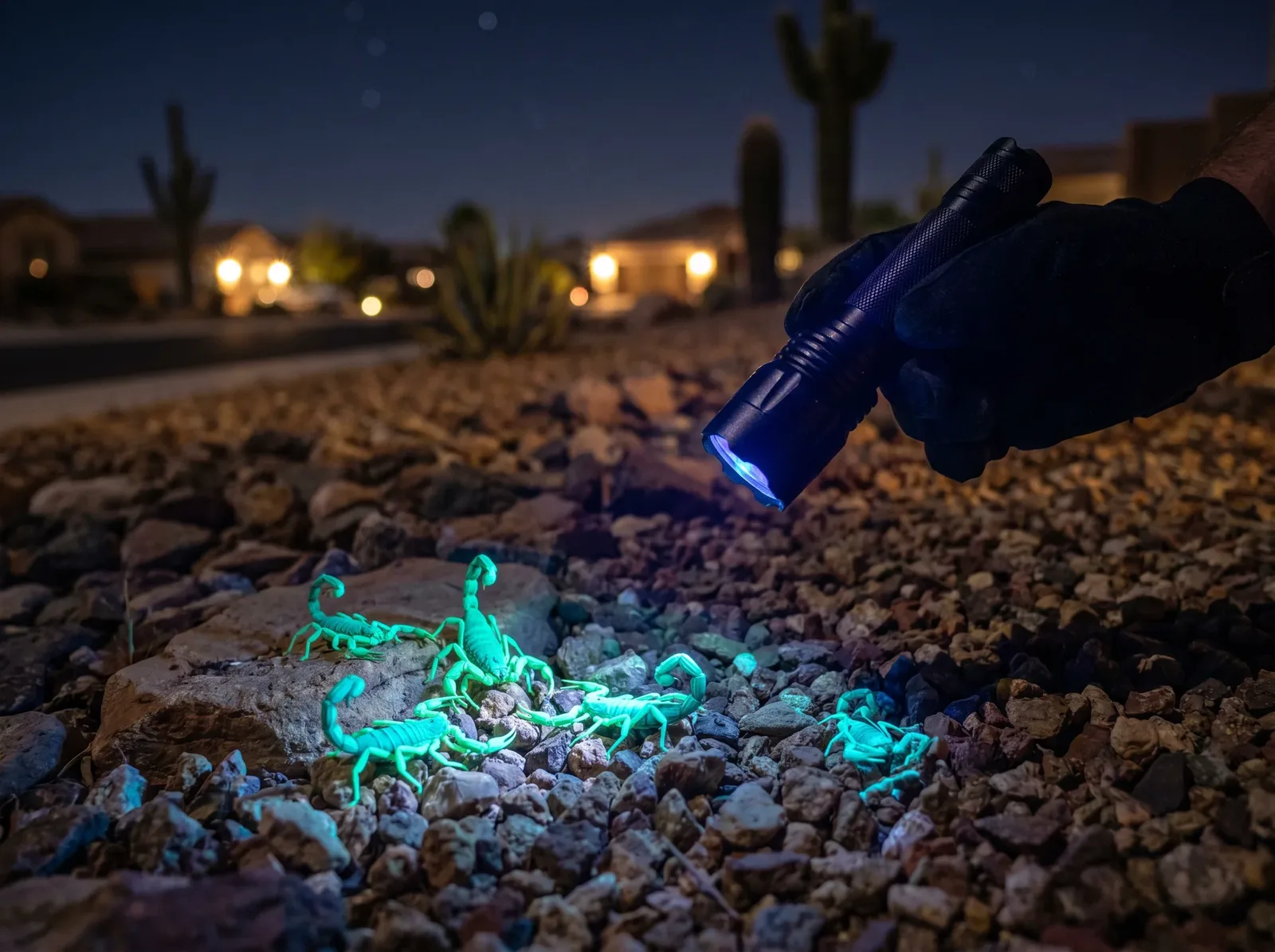
Every scorpion glows blue-green under ultraviolet light, and the University of Arizona notes you can spot one from several yards away. Buy an inexpensive UV flashlight, wait until an hour after dark, and walk the yard slowly: the base of the block walls, the foundation line of the house, rock beds, the patio and the pool equipment. Do not look into the beam; UV light can damage the eyes.
Read the result plainly. One scorpion on a walk is ordinary desert life. Several in one walk usually means a population is living on the property. Indoors, glue traps along baseboards and in the garage will tell you how much traffic you have over a week or two.
What keeps them out
Ordinary sprays are a disappointment with scorpions. University of Arizona extension writers have said insecticides are not an effective way to control them, and that the best management is to seal the house, clean up around it, and cut down the insects they eat. In practice that means three jobs:
- Seal the gaps. Weather-stripping around doors and windows, tight door sweeps, and caulk around eaves, pipes and wall penetrations. Leave weep holes open: they ventilate the wall, and plugging them causes other problems.
- Take away the cover. Move wood piles, planters and debris away from the walls. Prune shrubs and branches back from the house, since a branch touching the roof is a bridge to the attic.
- Cut the food supply. Fewer crickets and other insects around the house means fewer scorpions following them in. Fix leaky irrigation and do not leave standing water near the walls.
A homeowner can do most of this in a weekend. What a walk with a flashlight cannot tell you is where they are nesting inside the structure and which gaps they are using to get in. Our guide to scorpions in Las Vegas goes further into species, neighborhoods and sealing.
What Vegas Scorpion Control does
If the flashlight walk turns up more than you want to live with, this is the work we arrange for valley homes. Bark scorpions shrug off ordinary sprays, so it is built around sealing and treating where they actually live.
Call Vegas Scorpion Control
Four services, in the order most homes need them:
- Inspection. a survey of the house and yard: where scorpions shelter, how they get in, and how established the population is.
- Home sealing. doors, weep screed, vents and utility lines closed to the 1/16-inch gaps a bark scorpion uses.
- Targeted treatment. block wall voids, expansion joints and rock beds, plus control of the crickets they feed on.
- Seasonal prevention. recurring treatment through the April to October season so the population does not rebuild.
You get an itemized quote in writing before any work starts. Las Vegas, Henderson, North Las Vegas and the rest of the valley.
If someone is stung
Wash the area with soap and water and put a cool compress on it. Call Poison Control at 1-800-222-1222 for advice on any sting, and do not wait on a sting to a small child, an older adult or a pet. Call 911 for trouble breathing, swallowing or speaking, unusual eye movements, or muscle twitching. An antivenom exists, and Las Vegas hospitals treat serious cases.
Sources. University of Arizona Cooperative Extension, Scorpions (extension.arizona.edu) and Living with Scorpions, Backyard Gardener, August 28, 2019 (cales.arizona.edu); University of Arizona School and Home IPM Newsletter, June 2018; Las Vegas Sun, Creepy crawlers migrate to valley, November 15, 2006, quoting the Nevada state entomologist; America’s Poison Centers, 1-800-222-1222. Photos are illustrative images from Vegas Scorpion Control.
Vegas Scorpion Control writes for Vegas Scorpion Control. Vegas Scorpion Control publishes homeowner guides to the scorpions of the Las Vegas valley, from species and stings to sealing a house, and connects homeowners with local scorpion inspection. This piece was written for Top of Las Vegas.